If any part of Bristol best represents the spirit of this city it is our ‘Floating Harbour’ which has been transformed from the 1970’s dereliction of its post-industrial past to one of the most enjoyable and memorable visitor attractions in the UK. All this started with the valiant efforts of those in the City Docks Group and Civic Society in the late 60’s who fought to save much of the harbour from being filled in and covered and crossed with a spaghetti bowl of urban highways.
In the early 70’s a small group of us who recognised the importance of the last remaining working cranes to the spirit of the harbour, formed City Docks Ventures Ltd to save them from the scrap merchant who had bought them from the City Council. We subsequently handed the cranes we had bought back to the Council who now rightly celebrate them as a vital part of our industrial heritage, and of the iconic views from the City Centre and Pero’s Bridge. That small but significant move, which also resulted in us starting the Bristol Ferry Co, probably did more to open people’s eyes to the attraction and leisure potential of the harbour than anything else before or since. 50 years on the harbour is now worth hundreds of millions to our local economy!
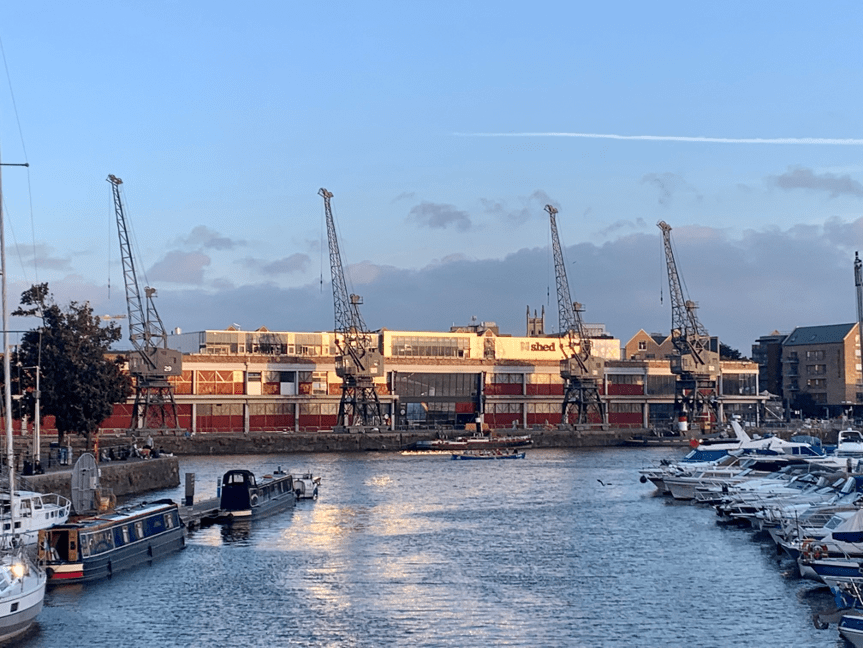
M-Shed and cranes viewed from Pero’s Bridge – photo George Ferguson
Wapping Wharf with its award winning M-Shed museum and its host of small independent businesses, largely in the shipping containers behind M-Shed, has been a model for mixed-use, medium-rise high-density development.
In the 18 years that I have known Stuart Hatton of Umberslade, the inspirational developer of the site, I have had nothing but admiration for his, and his previous architect’s, thoughtful approach to the development, leading me to propose it for awards for its remarkable approach to place making.
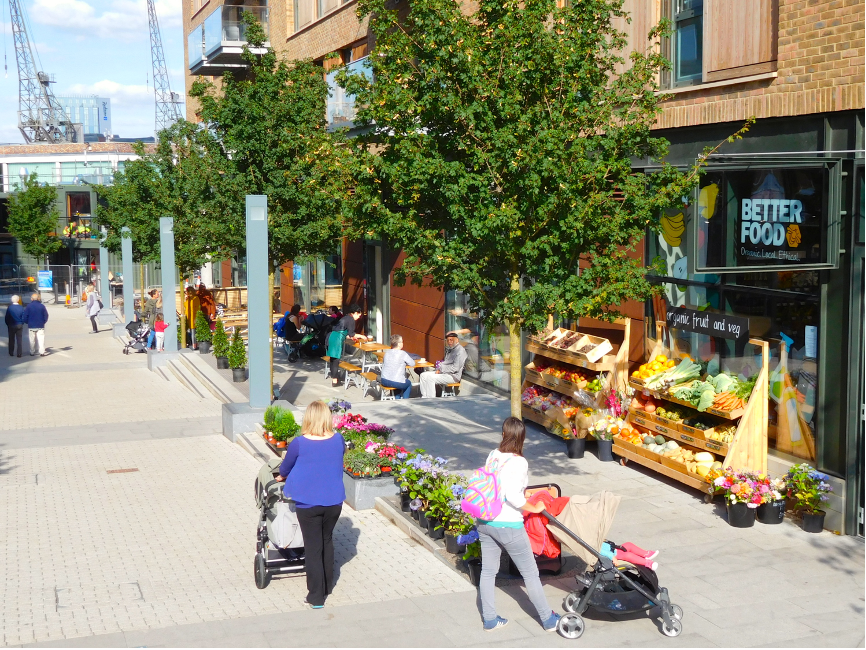
Gaol Ferry Steps looking down to M-Shed – view of cranes to be lost to 10/11 storey block. Photo George Ferguson
I made a significant contribution to the economic feasibility of the site when standing for Mayor in 2012 I promised to move the Metrobus route from crossing the historic Prince Street swing bridge and running along Museum Street behind the M-Shed. The planned route would have made the current Cargo development impossible and reduced the development area and value of the site
I took huge political flack in forcing this change through but it was the right thing to do, and in retrospect I doubt anyone would disagree. My only regret now is that the Prince Street Bridge is still open to cars!
So far so good, but let’s wind forward to today. The 4 cranes still stand proudly in front of the M Shed with their silhouettes against the sky. The importance of this was recognized in only adding a single storey to M-Shed when it was converted into our Museum of Bristol, maintaining its integrity as a transit shed and a view of the tower of St Paul’s Church Bedminster. To have built above this height would have caused uproar at the time.
However now we are faced with the dire prospect of 4 blocks, three directly behind M-Shed, rising in height to a 10/11 storey building facing the waterfront Museum Square. This is a major departure from the masterplan for the site which rose to a maximum of 7 storeys, set further back and hardly visible behind M-Shed, so retaining the prominence of the 4 listed cranes which are now the Museum’s largest exhibits and a distinctive part of Bristol’s townscape.
I know there has been some serious concern about the proposed removal of the Cargo containers, but this was always meant to be a temporary installation and has been a highly successful experiment in building a community of small independent traders. It would be unwarranted to prevent the developer from replacing the Cargo containers with a more permanent solution. The proposal to create a flexible ‘post-industrial’ style two-storey covered space behind M-Shed is an interesting one that seems to meet the approval of most traders. What is much more questionable is the plan to pile so many storeys on top of them. A housing crisis should never be used as a reason to wreck the soul of our city, but to look for solutions that do not compromise the great places that make Bristol what it is.
My criticism of the high blocks, proposed to rise well above the height of M-Shed, is that they break the skyline in a way that we successfully resisted from such proposals in the 60’s & 70’s and that they would mask the silhouettes of the cranes and incidentally block several views of St Paul’s Church. Claiming that these blocks of flats would be ‘landmark’ buildings is to demean the term, while the listed cranes are rightly described as such by the City Council on the M-Shed website: https://www.bristolmuseums.org.uk/m-shed/whats-at/working-exhibits/
The proposal for a steel framed ‘stepped’ building at the bottom of Gaol Ferry Steps, facing Museum Square is an interesting one, but 10/11 storeys is simply too high for the location, or for that matter, for any building in and around the harbour where masts and cranes should predominate. The proposed post-industrial style building would be just as exciting and provide wonderful views from it’s public viewing decks, while being much less intrusive if limited to a maximum of 7 storeys in line with the original masterplan, The other three blocks rising over the back of M-Shed are of lesser architectural significance and will appear as relatively ordinary blocks of flats that may provide special views for private residents but very much at the expense of Bristol’s distinctiveness and our public enjoyment.
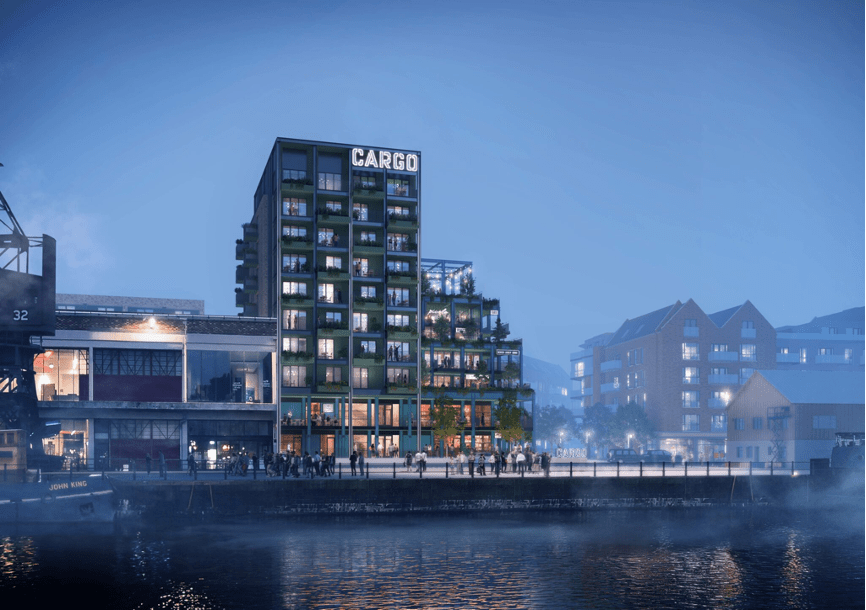
The proposed CARGO building at night including a 10/11 storey block adjacent to M-Shed. Image AHR Architects
Bristol, which is a very different city from Birmingham or Reading, has been cursed with a peppering of uncharacteristic high buildings, largely in the 60’s and 70’s but with more recently popping up in unsuitable places, encouraging other developers and landowners to follow. There is no strategic plan apart from an encouragement to ‘go for height’ from the mayor, who clearly has little regard for our history and townscape. Such an arbitrary policy can only result in a major loss of Bristol’s innate character. If our very special historic city is not to become ‘Little Birmingham’ we desperately need a skyline or high buildings policy that defines protected views and defends the historic areas from inappropriate development. Meanwhile we should have a moratorium on building high.
If it is now too late to save the Old City and Castle Park from high-rise development it is certainly not too late to save the character and skyline of our famous harbour. Let’s draw a 7 storey maximum line in the sky!
 People & Cities